
Beyond Semen Analysis: Could Sperm DNA Offer New Clues to Fertility?
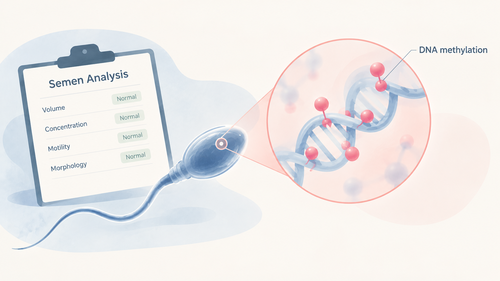
Conventional semen analysis remains a cornerstone of male fertility assessment, examining parameters such as sperm concentration, motility, and morphology.
Yet normal semen parameters do not always translate into the same reproductive outcomes. Some couples take considerably longer to conceive despite having no obvious abnormalities in standard semen analysis.
Could there be additional markers of male reproductive potential hidden within sperm DNA?
A recent study published in Human Reproduction explored this question by investigating the relationship between sperm DNA methylation variability and the time it takes couples to conceive naturally.
The researchers focused on DNA methylation, an epigenetic modification involved in regulating gene activity without altering the underlying DNA sequence.
Rather than examining average methylation levels at specific genes, they investigated how frequently an individual's sperm DNA methylation patterns deviated from the expected distribution.
Using data from 372 couples attempting natural conception in the US Longitudinal Investigation of Fertility and the Environment (LIFE) Study, the researchers developed a measure called Epigenetic Variability Outliers and Stochasticity (EVOS).
EVOS captures the accumulation of unusually high or low DNA methylation values across multiple genomic sites, providing an overall measure of individual sperm methylation variability.
The researchers then examined whether higher EVOS values were associated with how long couples took to achieve pregnancy.
The findings showed a clear pattern: higher sperm EVOS was associated with reduced fecundability and a longer time to pregnancy.
Couples in the highest quartile of EVOS had an estimated 66% probability of conceiving within 12 months, compared with 86% among those in the lowest quartile.
The association remained significant after adjusting for factors including male and female age, body mass index (BMI), and smoking status.
One particularly interesting finding emerged when the researchers restricted their analysis to 285 couples whose male partners met normal reference thresholds for several conventional semen parameters.
Even within this subgroup, greater sperm methylation variability remained associated with lower fecundability.
This suggests that sperm DNA methylation patterns may capture aspects of reproductive potential that are not fully reflected by conventional semen parameters.
However, the findings should be interpreted with caution.
This was an observational study of couples attempting natural conception. It does not establish that methylation variability directly causes reduced fertility, nor does it demonstrate that EVOS can predict outcomes in IVF or ICSI treatment.
The researchers also found no significant association between EVOS and live birth, gestational age, or newborn measurements. In addition, sperm motility was not included in the criteria used to identify men with normal semen parameters, and further validation will be necessary before EVOS can be considered for clinical use.
Still, the study raises an interesting possibility.
Male fertility assessment has traditionally focused on measurable sperm characteristics, including concentration, morphology, and motility.
Could understanding the epigenetic landscape of sperm provide another piece of the fertility puzzle?
The findings suggest that sperm DNA methylation variability may offer a promising direction for research into biomarkers that complement conventional semen analysis.