
Is freeze-all always the better strategy for low responders?
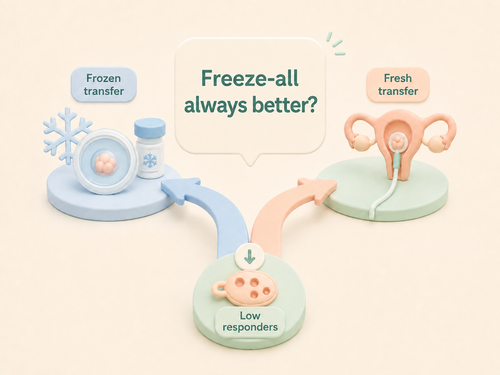
Freeze-all strategies have become an important part of modern IVF practice, especially as vitrification techniques and frozen embryo transfer outcomes have improved. But whether freeze-all is beneficial for all patient groups remains an important clinical question. Low responders are a particularly relevant population, because they often have fewer embryos available and may have less room for strategy-related trade-offs.
A recent systematic review published in Fertility and Sterility, “Frozen versus fresh embryo transfer in low responders,” examined whether frozen embryo transfer provides better outcomes than fresh embryo transfer in this group. The review screened 4,423 records and included one randomized controlled trial and 14 non-randomized studies.
The main conclusion was that freeze-all did not produce better reproductive outcomes compared with fresh embryo transfer in low responders. In fact, the authors reported that evidence from one randomized controlled trial suggested lower live birth, clinical pregnancy, and cumulative live birth outcomes with frozen embryo transfer. They also noted that any potential benefit of fresh transfer may be related to a more physiological endometrial environment or the avoidance of embryo injury from cryopreservation.
The paper does not mean that frozen embryo transfer is inappropriate for low responders in every situation. Rather, it highlights the need to avoid applying freeze-all as a one-size-fits-all strategy. For IVF teams, this review may be useful when discussing whether the advantages of frozen transfer truly outweigh the potential trade-offs in patients with limited embryo yield.