
Does PGT-A Improve Live Birth Outcomes in Routine IVF Practice?
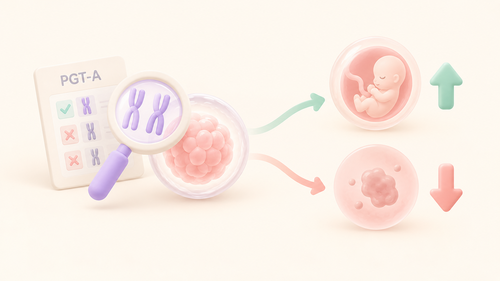
Preimplantation genetic testing for aneuploidy (PGT-A) is used to identify chromosomally normal embryos and support embryo selection for transfer.
By prioritizing euploid embryos, PGT-A is intended to reduce unsuccessful transfers and pregnancy loss.
But evaluating its effectiveness depends partly on what outcome we choose to measure.
The chance of success from a single embryo transfer and the cumulative chance of achieving a live birth from one oocyte retrieval are not necessarily the same question.
A recent study published in Reproductive BioMedicine Online explored this distinction using real-world data from the UK Human Fertilisation and Embryology Authority (HFEA) registry.
The researchers analyzed 111,975 treatment episodes initiated between 2014 and 2018.
Each episode included the initial oocyte retrieval and all subsequent embryo transfers associated with that retrieval.
PGT-A was used in 2,243 of these episodes.
The analysis compared PGT-A cycles with standard IVF cycles without PGT, adjusting for multiple clinical factors including maternal age, cause of infertility, previous IVF treatment, ovarian stimulation, ICSI, number of oocytes and embryos, and treatment centre.
PGT-A was associated with a lower likelihood of a live birth following the first embryo transfer:
- First-transfer live birth event: OR 0.86 (95% CI 0.77–0.97)
When all transfers originating from the same oocyte retrieval were considered, the association was stronger:
- Cumulative live birth event: OR 0.74 (95% CI 0.67–0.82)
Pregnancy loss, however, showed a different pattern.
Among pregnancies, PGT-A was associated with lower pregnancy loss both following the first transfer (OR 0.47) and cumulatively across the treatment episode (OR 0.64).
Another notable finding was the difference in whether embryos reached transfer.
In 48% of PGT-A treatments, no embryo was transferred in the first cycle, compared with 5% of standard IVF treatments.
The study therefore presents an interesting contrast: PGT-A was associated with a lower risk of pregnancy loss, while also being associated with a lower cumulative likelihood of live birth per treatment episode.
These findings should not be interpreted as evidence that PGT-A itself causes lower live birth rates.
This was a retrospective observational study rather than a randomized controlled trial.
Although the researchers adjusted for a broad range of patient and treatment characteristics, unmeasured differences in patient selection and clinical practice may still have influenced the findings.
The data also reflect UK practice between 2014 and 2018. PGT-A technologies, approaches to mosaic embryos, and embryo transfer strategies have continued to evolve since then, meaning the results should not automatically be generalized to all contemporary PGT-A practice.
Still, the study raises an important question about how embryo-selection technologies should ultimately be evaluated.
Should success be defined mainly by how efficiently a selected embryo reaches live birth, or should it also consider how effectively the full reproductive potential of an oocyte retrieval is utilized over multiple transfers?
Reducing pregnancy loss and maximizing cumulative live birth may both be valuable goals, but they are not necessarily the same outcome.
And that distinction may be just as important as the technology used to select the embryo.