
Revisiting IVF add-on evidence: Intrauterine hCG
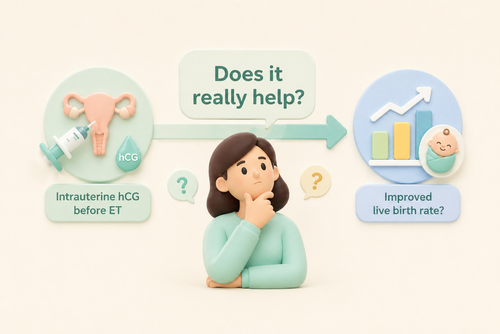
Intrauterine hCG administration before embryo transfer has been discussed as a potentially promising IVF add-on. The biological rationale is understandable: hCG is one of the earliest signals produced by the embryo and has been thought to play a role in implantation. Earlier reviews had suggested possible improvements in clinical pregnancy or live birth, but the evidence remained mixed and the differences across studies were difficult to ignore.
A recent paper by Zou et al., published in Human Reproduction Update in 2026, revisited this question in “Intrauterine human chorionic gonadotropin administration before embryo transfer (IHABT): an individual participant data meta-analysis of randomized controlled trials.” Rather than relying only on published summary results, the authors performed an individual participant data meta-analysis of randomized controlled trials. Seven trustworthy RCTs involving 2,244 participants were included in the main analysis, and six of the seven had an overall low risk of bias.
The key finding was clear: intrauterine hCG before embryo transfer did not improve live birth rates or clinical pregnancy rates in the IPD analysis. That matters because it suggests that the more optimistic signals seen in earlier literature may not hold up when the evidence is filtered more strictly for quality and reliability.
For IVF teams, this paper is interesting not only because of the result itself, but because of what it says about add-ons more broadly. A plausible mechanism and early enthusiasm do not always translate into meaningful clinical benefit. In that sense, this study is less about one intervention alone and more about the value of revisiting familiar practices with stronger evidence.