
AI Helps Improve Pregnancy Success Rates: 1.5 Times Better Than Humans at Identifying High-Quality Embryos
Concerns are growing that Korea’s ultra-low birth rate could pose a serious threat to the country’s future. As the average age of marriage continues to rise, the number of couples struggling with infertility is also increasing.
Hyejun Lee, CEO of Kai Health and a board-certified obstetrician-gynecologist, spent years treating infertility patients in clinical practice and thinking about how to improve pregnancy success rates. Her answer was embryo selection technology powered by artificial intelligence. With this idea, she won the Seoul National University College of Medicine startup competition and founded Kai Health in October 2021.
In a recent interview, Lee said, “Embryos are the single most important factor in infertility treatment. I founded the company to help couples in Korea and abroad by using AI to identify the most viable embryos and improve the success rate of IVF procedures.”
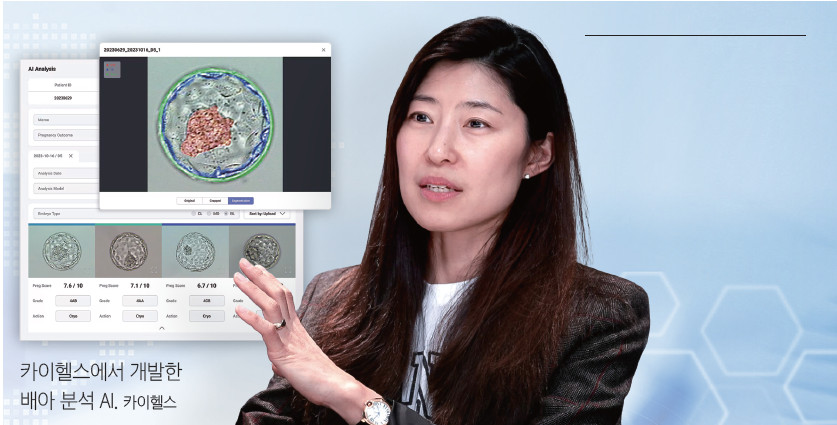
Kai Health developed Vita Embryo, an AI solution designed to identify the most viable embryos, and has obtained medical device certifications in Europe, Singapore, and India. In January 2025, it became the first product of its kind in Korea to receive Class III approval from the Ministry of Food and Drug Safety and was also designated as a new health technology under the deferred assessment pathway. The company has also been selected as one of the Top 10 flagship projects of 2025 by the Korea Medical Device Development Fund, drawing attention as a promising technology to help address the country’s low birth rate. The following are excerpts from the interview.
What led you to take on the challenge of developing AI to identify the most viable embryos?
“The causes of infertility are complex, ranging from male factor infertility to uterine or egg-related issues in women. In the end, however, healthy, high-quality embryos are critically important, accounting for as much as 80% of pregnancy success. Before IVF is performed, an embryologist first examines the embryos under a microscope and selects the most viable ones. Because this process relies on human judgment, it inevitably involves subjectivity and can vary significantly from person to person.”
What are the key features of Vita Embryo?
“Vita Embryo uses an AI algorithm trained on embryo images and pregnancy outcome data from Korea and the United States to identify embryos with a higher likelihood of resulting in pregnancy. Its core function is to evaluate embryo morphology before transfer and help identify embryos more likely to develop successfully into a fetus. Once an embryo image is captured under a microscope, the AI analyzes it in real time.”
How strong is Vita Embryo’s embryo selection performance?
“In tests involving 61 clinicians, Vita Embryo was found to outperform humans in selecting embryos likely to lead to pregnancy. While humans selected embryos with higher implantation potential at a rate of around 30%, the AI identified high-quality embryos at a rate of around 65%. Because the volume of training data continues to grow, Vita Embryo’s performance is expected to keep improving.”
I understand that the company has also entered overseas markets.
“We recently signed a five-year agreement with one of India’s largest fertility center networks. We have already obtained medical device certifications in Europe, Singapore, and India, and we are currently preparing for the FDA approval process to enter the U.S. market.”
The support from the Korea Medical Device Development Fund must also have been meaningful.
“For startups, the financial burden goes far beyond R&D. Clinical trials and regulatory approvals also require substantial resources, and the Korea Medical Device Development Fund provided meaningful support in that regard. Overseas regulatory processes can also involve significant administrative challenges, and the Fund helped open channels for discussion, which allowed us to enter international markets more quickly.”
Source: Economy Chosun · By Ji-yoon Heo · Originally published in Korean