
[MedTech, Team Korea] (4) AI Helps Improve IVF Outcomes: Embryo Selection Accuracy Said to Be Twice That of Humans
Kai Health becomes the first in Korea to commercialize embryo-selection AI
An OB-GYN specialist founded the company to improve pregnancy outcomes
“Certified in Europe, Singapore, and India; pursuing U.S. FDA clearance as well”
In Korea, concerns are growing that the country’s low birth rate could threaten its long-term viability. As the average age at marriage continues to rise, more couples are experiencing infertility. The number of male and female patients diagnosed with infertility in Korea is estimated at around 240,000 per year. According to the Health Insurance Review and Assessment Service (HIRA), 136,906 patients underwent infertility treatment (assisted reproductive technology) in 2023.
Hyejun Lee, CEO of Kai Health, is an obstetrician-gynecologist who treated many infertility patients in hospitals and continued searching for ways to improve pregnancy outcomes. She found her answer in embryo-selection technology based on artificial intelligence (AI). With this idea, she won a startup competition at Seoul National University College of Medicine, and in October 2021, she founded Kai Health.
Meeting Lee at Kai Health’s office in Seoul’s Gangnam district, she said, “The most important thing in infertility treatment is the embryo,” adding, “I founded the company to help couples in Korea and abroad by using AI to select the optimal embryo and improve IVF success rates.”
Kai Health developed Vita Embryo, an AI system designed to identify the most suitable embryos. Following medical device certifications in Europe, Singapore, and India, the company obtained Korea’s first Class III approval from the Ministry of Food and Drug Safety (MFDS) in January 2025 and was designated as an innovative medical device. It was also selected as one of the 10 flagship projects for 2025 under Korea’s pan-ministerial full-cycle medical device R&D program, drawing attention as a technology that could help address the low birth rate.
AI to improve the likelihood of success in infertility treatment
In vitro fertilization (IVF), often referred to as the “test-tube baby” procedure, involves retrieving eggs from the ovaries, fertilizing them with sperm, and transferring the resulting embryo into the uterus. To improve the chances of success, having more eggs is important. To induce ovarian hyperstimulation, patients self-inject follicle-stimulating hormone daily for about 10 to 14 days. This process can be a major physical and emotional burden.
Even when fertilization succeeds, IVF has a relatively low success rate per cycle—around 30%. Lee said, “The causes of infertility are complex—such as male sperm factors and female uterine or egg factors—but ultimately, a healthy, high-quality embryo is so important that it accounts for as much as 80% of pregnancy success.”
Before IVF transfer, an embryologist first selects healthy embryos by examining them under a microscope. Lee noted, “Because this is a human task, subjectivity can come into play, and variability can be large.” Vita Embryo, developed by Kai Health, uses an AI algorithm trained on embryo images and pregnancy outcome data from Korea and the United States to help identify embryos with a higher likelihood of pregnancy.
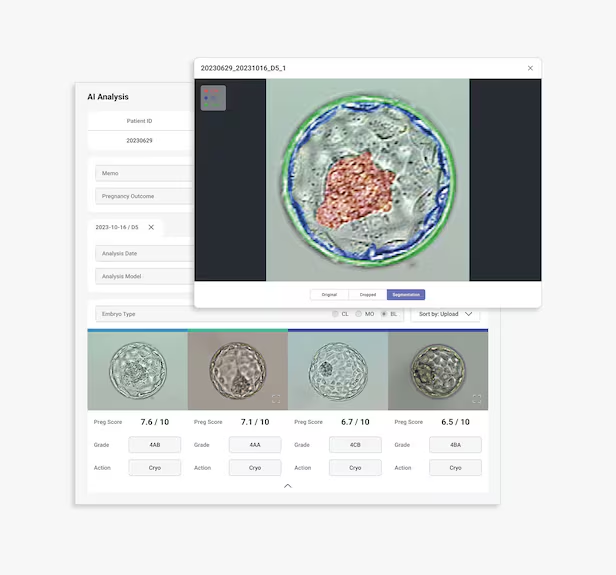
Lee explained, “The core of Vita Embryo is that, before a fertilized embryo is implanted into the uterus, AI evaluates the embryo’s morphology and selects one that is more likely to develop well into a fetus,” adding, “When an embryo image is captured through a microscope, the AI analyzes it in real time.”
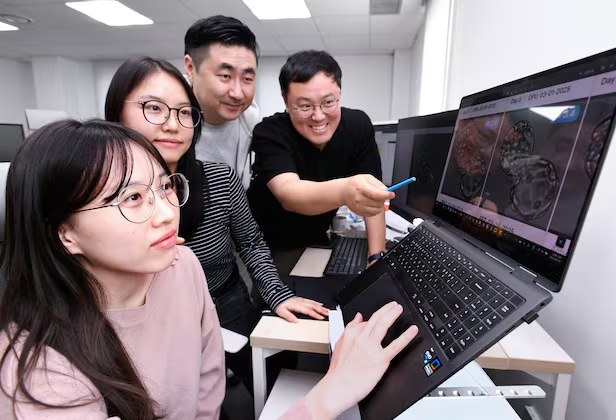
To develop the embryo-selection AI, the team began by collecting and analyzing domestic and international data. The solution was co-developed with the research group led by Professor Jeong-ryeol Lee of the Department of Obstetrics and Gynecology at Seoul National University Bundang Hospital. The team conducted a clinical trial for infertility patients at Bundang Seoul National University Hospital using the AI model.
Based on the clinical trial results, the company said Vita Embryo was evaluated as outperforming humans in selecting embryos likely to result in pregnancy. While the probability of a human selecting a high-likelihood embryo was around 30%, the company said the AI’s probability of selecting high-quality embryos was around 65%.
Lee said, “Infertility is painful in itself, and the emotional wounds from failure can be profound,” adding, “By transferring embryos with a higher likelihood of success through Vita Embryo, we can increase predictability and reduce the time and cost required to achieve pregnancy.” She also said that because the amount of training data continues to grow, Vita Embryo’s performance will keep improving.

“Pursuing overseas expansion; government support has been a major help”
Kai Health plans to deliver meaningful business results in the domestic market this year while also pursuing overseas expansion. Lee cited last month’s designation by HIRA related to the New Health Technology assessment pathway as a key milestone. Next, through the National Evidence-based Healthcare Collaborating Agency (NECA), the technology may be recognized as a New Health Technology or be granted an assessment deferment.
Kai Health is aiming for the New Health Technology assessment deferment program. This program defers assessment for new medical technologies that require early adoption, allowing them to be used in clinical settings earlier as non-reimbursed services. Lee said, “Our goal is to secure a non-reimbursed fee schedule within the year through the assessment deferment program.”
The company is also targeting global markets. Lee said, “We have already obtained medical device certifications in Europe, Singapore, and India, and we are preparing the FDA (Food and Drug Administration) clearance process for entry into the U.S. market.” She added that infertility exists in every country, and that globally, rising marriage age and various environmental issues are contributing to increasing numbers of infertility patients.
Lee emphasized that government support programs played a major role from technology development through market entry. Kai Health received a total of KRW 1.6 billion in research funding through Korea’s pan-ministerial full-cycle medical device R&D program. This national initiative is jointly led by government ministries including the Ministry of Science and ICT, the Ministry of Trade, Industry and Energy, the Ministry of Health and Welfare, and the Ministry of Food and Drug Safety, and supports the full lifecycle of medical device R&D.
Lee said that for startups, the cost burden is significant not only for R&D but also for clinical trials and regulatory certifications, and that the program’s financial support made it possible to pursue the business with greater peace of mind. She added that there are also administrative challenges in certification processes both in Korea and overseas, and that the program helped create channels for discussion that enabled faster market entry.
Beyond improving Vita Embryo’s performance and expanding its market reach, Kai Health also plans to pursue R&D on environments that can optimize embryos and technologies that can better culture eggs from women experiencing infertility. Lee said, “We will continue working to grow as a company that eases the pain of many couples facing infertility and provides solutions that help them meet a healthy baby.”
Source: ChosunBiz · By Ji-yoon Heo · Published May 19, 2025 (06:00 KST) · Originally published in Korean · English translation