
AI Analysis of 2,061 Mouse Oocytes Finds Culture Responses Vary by Phenotype
Three phenotypes identified from imaging features, with baseline blastocyst formation rates ranging from 28.2% to 42.4%
Responses to resveratrol and vitamin B12 also varied by phenotype; further validation is needed before application to human oocytes
An analysis of mouse oocytes classified into three phenotypes based on imaging characteristics found differences not only in blastocyst formation rates, but also in their responses to culture conditions supplemented with resveratrol and vitamin B12.
The findings suggest the potential for research into personalized culture strategies in which culture conditions are tailored to oocyte characteristics. However, the study did not evaluate the effectiveness of personalized culture in human oocytes.
Fertility AI company Kai Health announced on October 1 that the study, conducted jointly with the Maria Fertility Research Institute and Maria Medical Foundation, had been published in the international journal Reproduction and Fertility. The paper was first published online on September 8 and formally published on September 21.
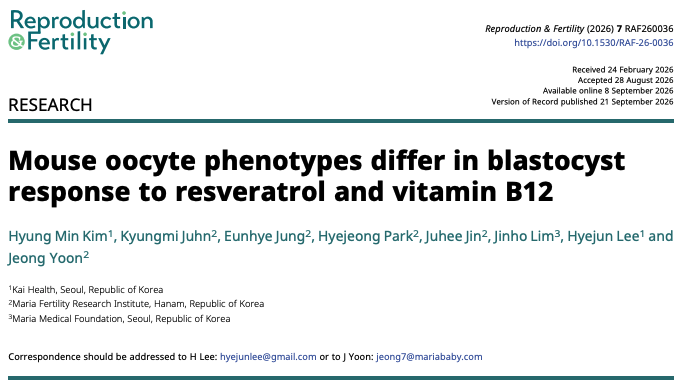
The laboratory study involved 2,061 mouse oocytes collected between January 2023 and December 2024, with blastocyst formation as the primary outcome.
The researchers quantified imaging features from brightfield images of the oocytes, including size, shape, brightness, and cytoplasmic texture. Using an unsupervised Gaussian Mixture Model (GMM), the oocytes were classified into three phenotypes. The phenotypes were first defined using 695 oocytes cultured under control conditions and were then applied to the remaining 1,366 oocytes to assess blastocyst formation under different culture conditions.
Under control conditions, blastocyst formation rates were 28.2% (44/156) for Cluster 1, 42.4% (156/368) for Cluster 2, and 34.9% (105/301) for Cluster 3. Cluster 2 showed significantly higher blastocyst formation rates than Cluster 1 (P=0.002) and Cluster 3 (P=0.048). When analyzed by age, blastocyst formation rates were similar across phenotypes in younger oocytes, while Cluster 2 showed significantly higher rates than Clusters 1 and 3 among older oocytes.
Responses to culture supplementation also differed by phenotype. In Cluster 1, the blastocyst formation rate increased from 28.2% under control conditions to 48.7% with vitamin B12 at 200 pM and 45.1% with resveratrol at 1.0 μM. In Cluster 3, the rate increased from 34.9% to 60.4% with vitamin B12 at 50 pM and 50.0% with resveratrol at 0.1 μM. In contrast, Cluster 2, which had the highest baseline blastocyst formation rate, showed no statistically significant improvement under any of the tested supplementation conditions.
The researchers also conducted a post hoc analysis in which the culture condition associated with the highest blastocyst formation rate was selected for each of six subgroups defined by oocyte phenotype and age. Overall blastocyst formation was 36.97% (305/825) under control conditions, compared with 56.00% (126/225) when the best-performing condition for each subgroup was combined (P<0.001).
However, this was not a prospective experiment in which oocytes were first classified by phenotype and then assigned to a corresponding culture condition. The paper notes that the findings represent post hoc associations within the existing dataset, and further studies are needed to determine whether phenotype-guided selection of culture conditions can actually improve blastocyst formation.
The study was conducted at a single research center using mouse oocytes and evaluated outcomes only through blastocyst formation. It remains unknown whether the findings can be reproduced in human oocytes or translated into improvements in pregnancy or live birth outcomes. The researchers noted that external validation and further studies involving human oocytes will be required.
Kai Health has commercialized Vita Embryo, an AI-based embryo analysis solution that has received approval from Korea’s Ministry of Food and Drug Safety and is available as a non-reimbursed medical service under the New Health Technology Assessment deferral program. Building on the latest findings, the company plans to expand its research into how the characteristics of oocytes and embryos interact with their culture environment.
Jeong Yoon, Director of the Research Support Division at Maria Medical Foundation, said, “This study is meaningful in that it combined our experience in fertility treatment and embryo culture with AI technology to identify differences in culture responses according to oocyte characteristics. We will continue our research toward identifying personalized culture environments suited to individual characteristics.”
Hyejun Lee, CEO of Kai Health, said, “In fertility treatment, every patient, oocyte, and embryo has different characteristics. Kai Health will continue to use data to better understand these differences and build the scientific foundation for more consistent and personalized fertility treatment.”
The study was supported by the Korea Medical Device Development Fund. According to the paper, first author Hyung Min Kim is an employee of Kai Health, while co-corresponding author Hyejun Lee is a shareholder of the company.
Source: Digital Chosun Ilbo (Dizzo.com) · By Jung-a Kim · Originally published in Korean · Published on October 1, 2026
This English version is a translation of the original Korean article and is provided by Kai Health for informational purposes.